
Engineering a Seam That Joins Embroidery to Weaving
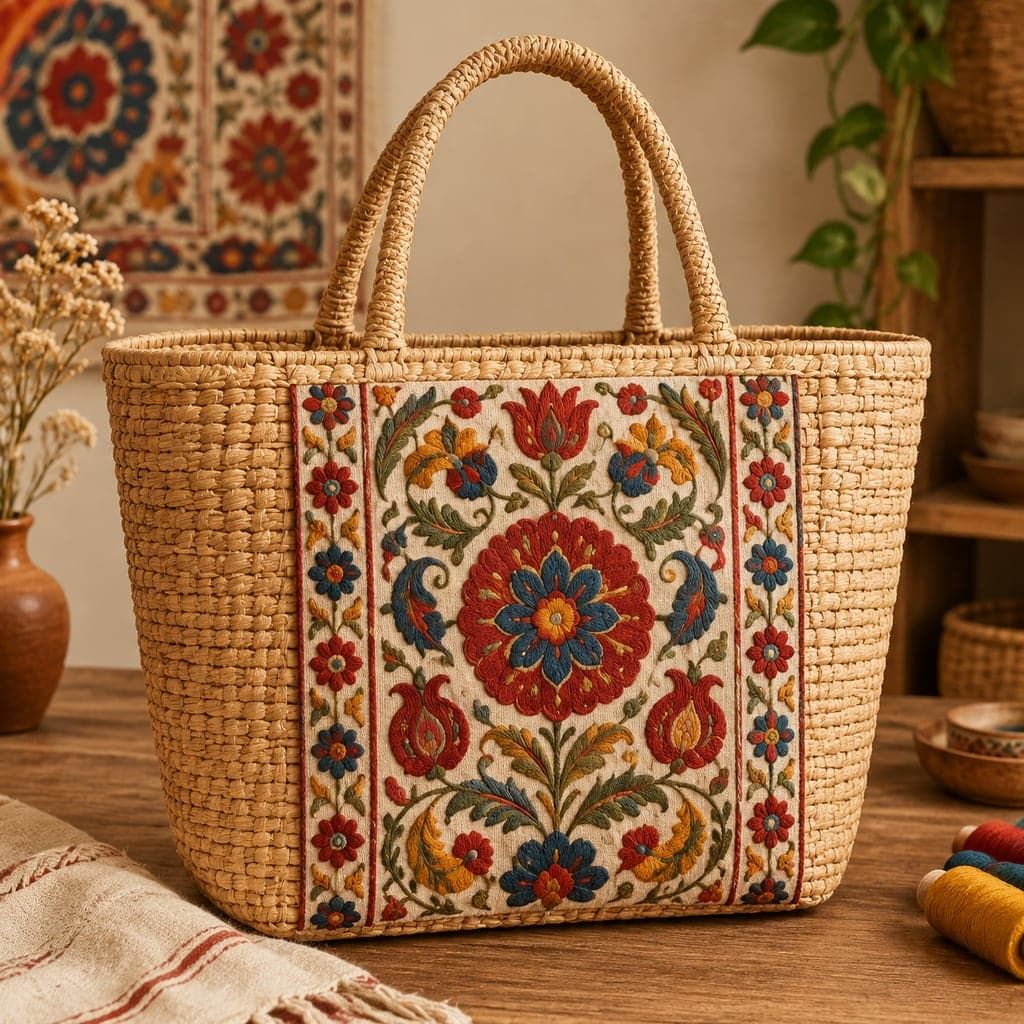
Joining a rigid hand-woven rattan body to a soft high-density embroidered canvas panel is the construction most factories refuse. Stitched naively, the seam distorts, cane tips fray through the fabric, and the handle anchor fails under load. This case documents the three changes that make the joint hold.
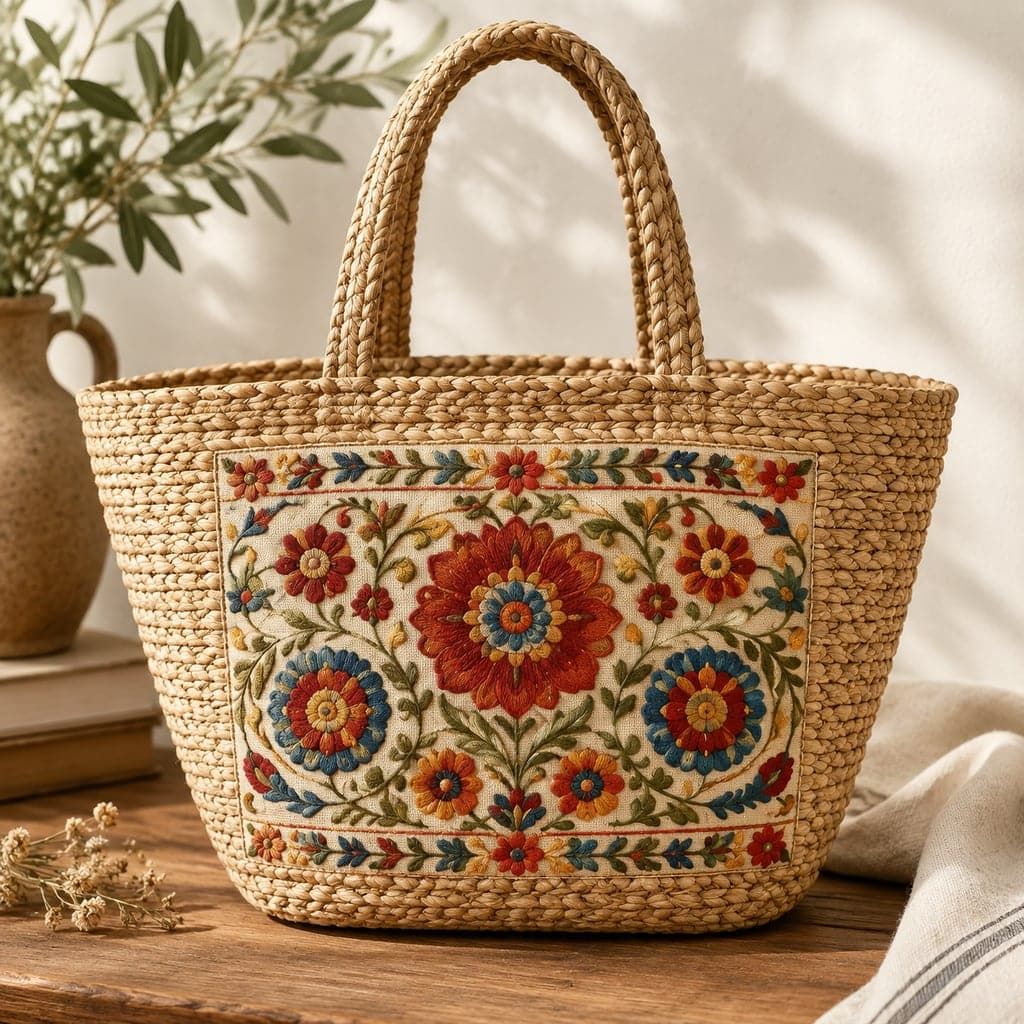
Why the naive seam fails
- Modulus mismatch — rattan resists bending; 18oz embroidered canvas conforms. Under load the two move differently and the seam absorbs the difference until it distorts.
- Fibre tips pierce fabric — cut cane ends are sharp. In a plain seam they work through the canvas from the inside within weeks of retail display.
- Handle anchor is a stress concentrator — the point where the strap meets the rim carries the full dynamic load of the bag contents.
The three changes that fix it
- Internal flexible memory core — a lightweight high-recovery boning layer sits under the seam rim, creating a transitional tension zone between the rigid cane and the soft canvas.
- Bound edge with dual reverse lockstitch — thick piping plus two passes of reverse lockstitch hermetically seals the raw cane tips, stopping burrs and fraying.
- Leather pads and solid brass rivets — vegetable-tanned pads spread the load at the handle anchor, doubled with hollow brass rivets. Tested above 15kg vertical dynamic load without loosening.
The problem nobody quotes for
Joining a rigid woven body to a supple embroidered panel is where mixed-media bags usually fail. The two materials shrink at different rates after dyeing, so a panel cut to match the weave on day one can pull, pucker or fray by the time the bag is blocked. Most factories quote the construction without noticing the mismatch.
The fix was to draft both components from the same shrinkage figure rather than from the same finished measurement. The panel is tensioned to that figure before assembly, and the weave is steamed to the same state, so the seam sees two materials behaving alike at the moment they are joined.
It is not a technique any buyer asks for by name. It is the difference between a mixed-media bag that still looks expensive after a season and one that has visibly moved at the seam, and it is why this study is published as an engineering note rather than a product page.
The measurement that matters here is not a cost or a date but the load the seam can carry. The finish is a bound edge with a dual reverse lockstitch over a flexible high-recovery core, and the anchor is tested to 15kg+ vertical dynamic load. That is what keeps the embroidered panel and the woven body moving together instead of tearing at the join.
Quick Answers: MOQ, Sampling & Lead Times
Short, self-contained answers to the questions buyers ask most about this programme.
- Do we pay extra for this construction?
- No. It is how we build mixed-media styles by default, because the alternative fails after a season and comes back as a claim. What it does change is the sampling sequence: the panel has to be tensioned before assembly, which adds a step a plain woven style does not have.
- Why publish an engineering note instead of a product page?
- Because there is no single product behind it. The finding applies to every mixed-media style we cut, so it belongs to the process documentation rather than to one SKU. Buyers evaluating several suppliers can use it as a question to ask, which is a more useful outcome than another catalogue page.
- Can you apply this to a canvas and leather mix?
- Yes. Leather behaves in the opposite direction to natural fibre: it relaxes rather than shrinks, so the leather component is cut to its relaxed state and the panel or canvas is pre-shrunk to match. The principle is identical; only the direction of the correction changes.
Production & Customization FAQ
Why is mixed media harder than all-embroidered or all-woven?
Because it combines two materials with opposite stiffness in one seam. Each is straightforward alone; the difficulty is entirely in the joint, which is where cheap construction shows up as fraying and distortion.
Can you prototype a mixed-media design from a photo?
We can start from photos, but a physical reference gets you to an accurate prototype far faster. If you have no sample, expect one extra sampling round to converge on the seam behaviour.
Continue reading
- Case Studies
- Hjem Studio: 80-Piece Pilot to Seasonal Scale
- 500 Bespoke Embroidered Clutches for a Parisian Resort Capsule
- What drives bag unit cost
- Bag sampling process
- Request a Bag Manufacturing Quote
- Which model fits your brand
- Mixed-Media: Embroidery Meets Weaving
- Flat Embroidery (Satin Stitch)
- Sample Development