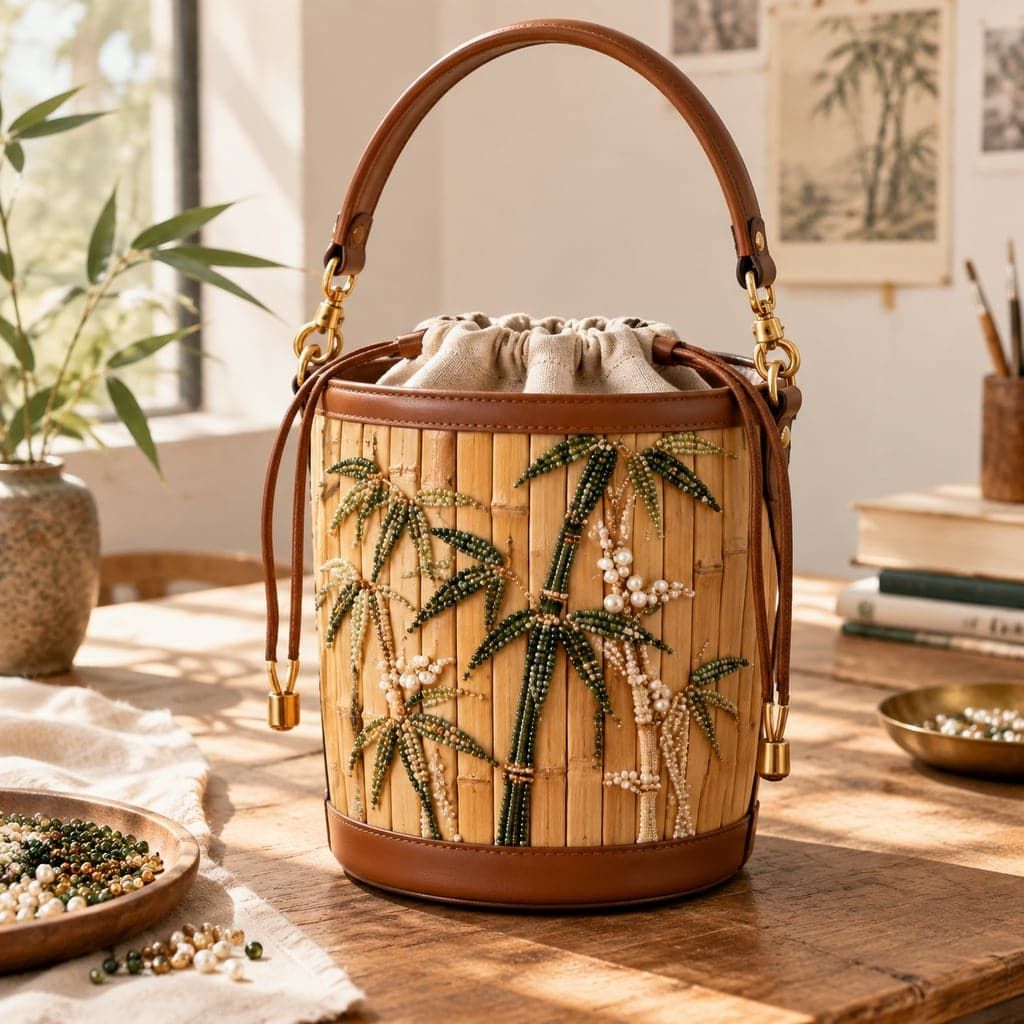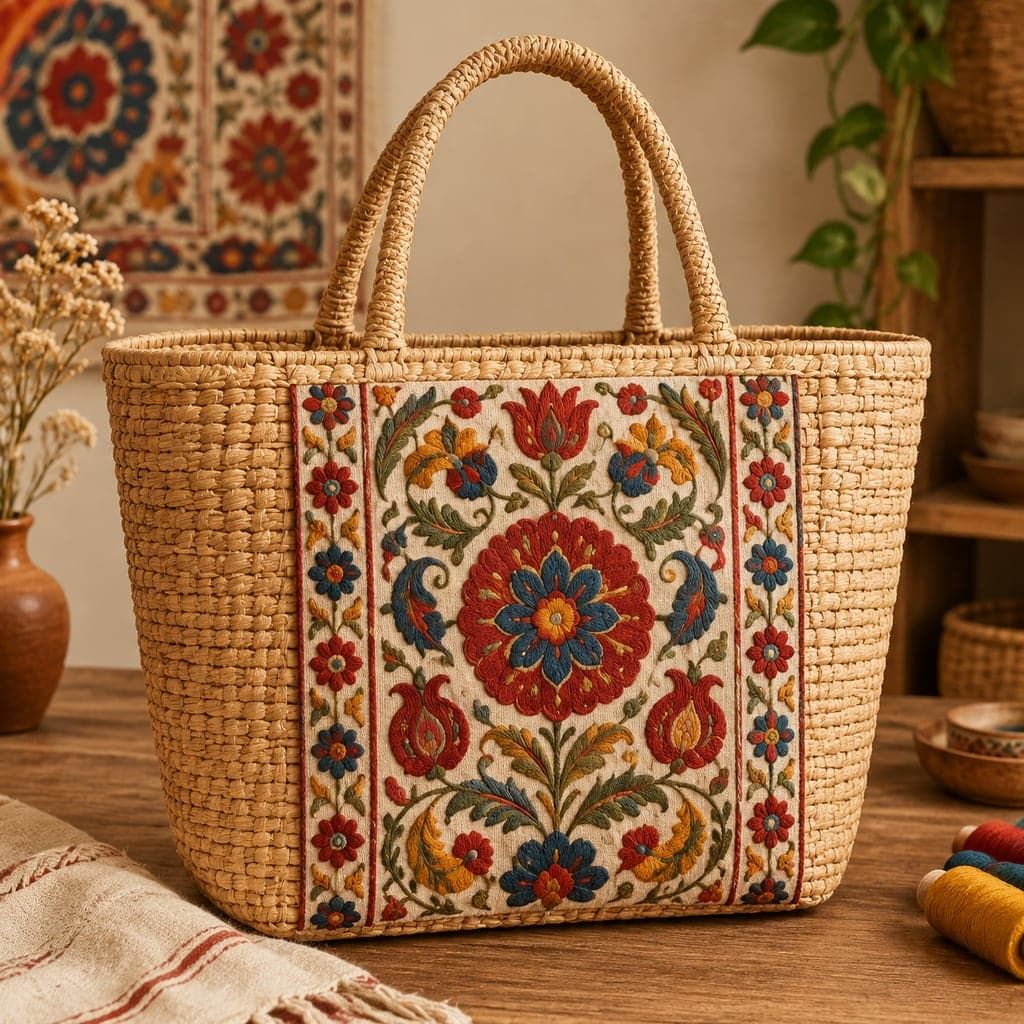
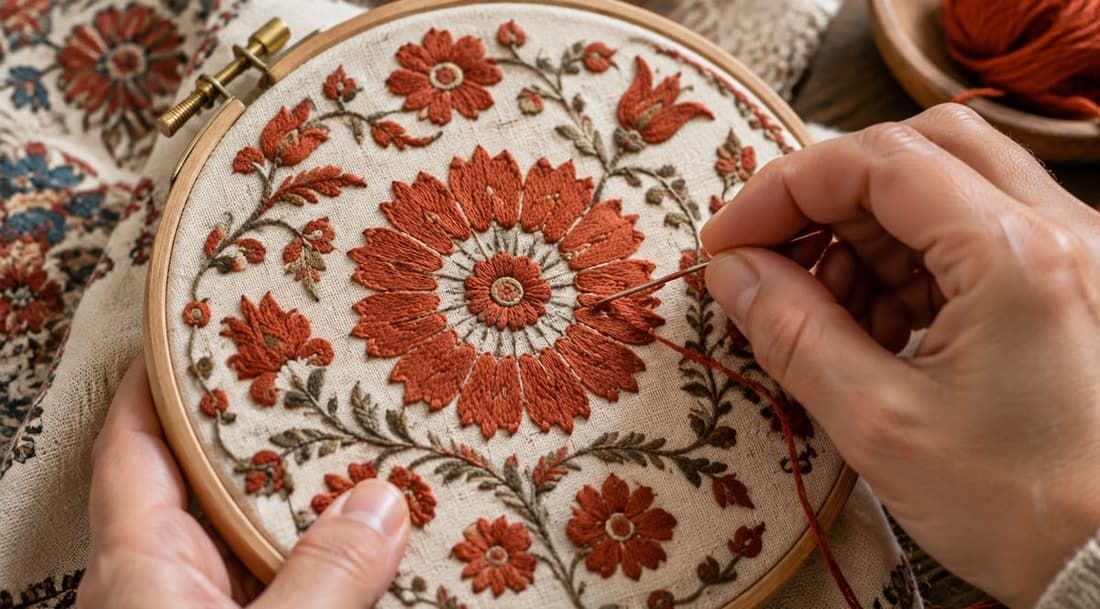
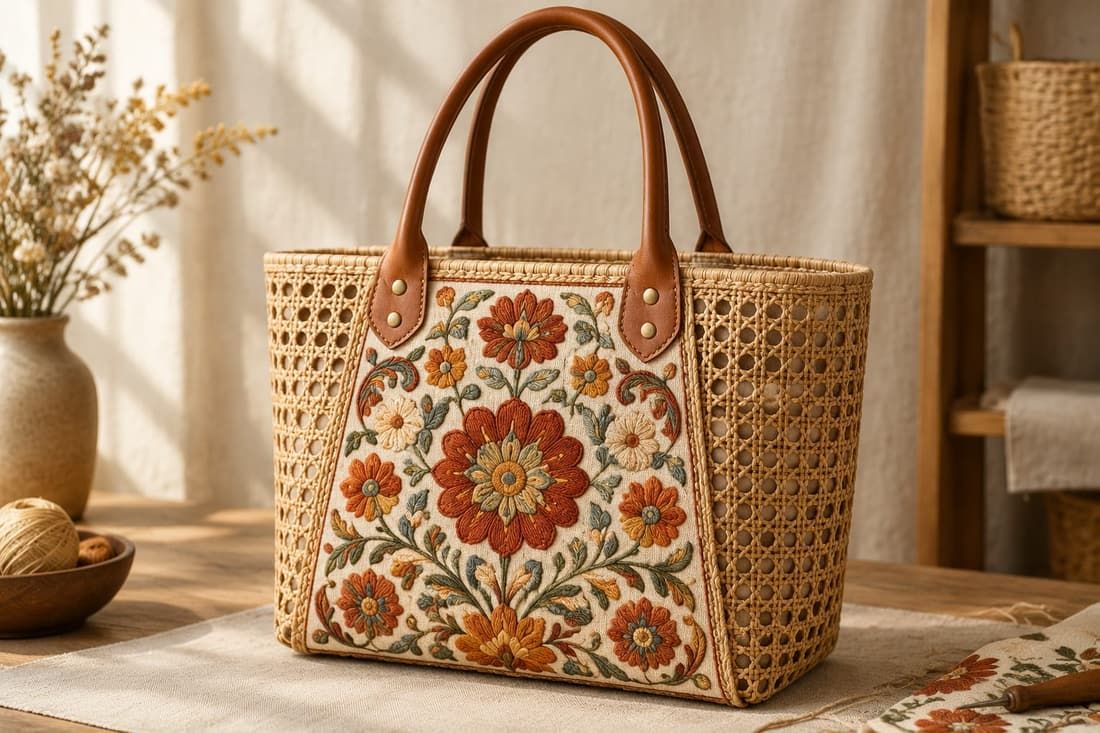
Marrying two fundamentally opposite materials — a rigid, organic 3D hand-woven basket and a supple, high-density embroidered cotton canvas — has long been a notorious bottleneck in luxury accessory manufacturing.
Conventional factories attempt to machine-stitch embroidered panels directly onto natural rattan peel. The outcome is predictably flawed: fiber slippage, needle breaks, seam distortion, and frayed edges within weeks of retail display.
Pillar 1: Internal Flexible Memory Core
At TelvaBag atelier, we engineer an ultra-lightweight, high-recovery internal memory boning layer beneath the seam rim. This creates a balanced transitional tension between the rigid Indonesian wild rattan and the 18oz combed cotton canvas. The bag maintains its crisp architectural silhouette even under heavy loads.
Pillar 2: Invisible Reverse Lockstitch & Edge Binding
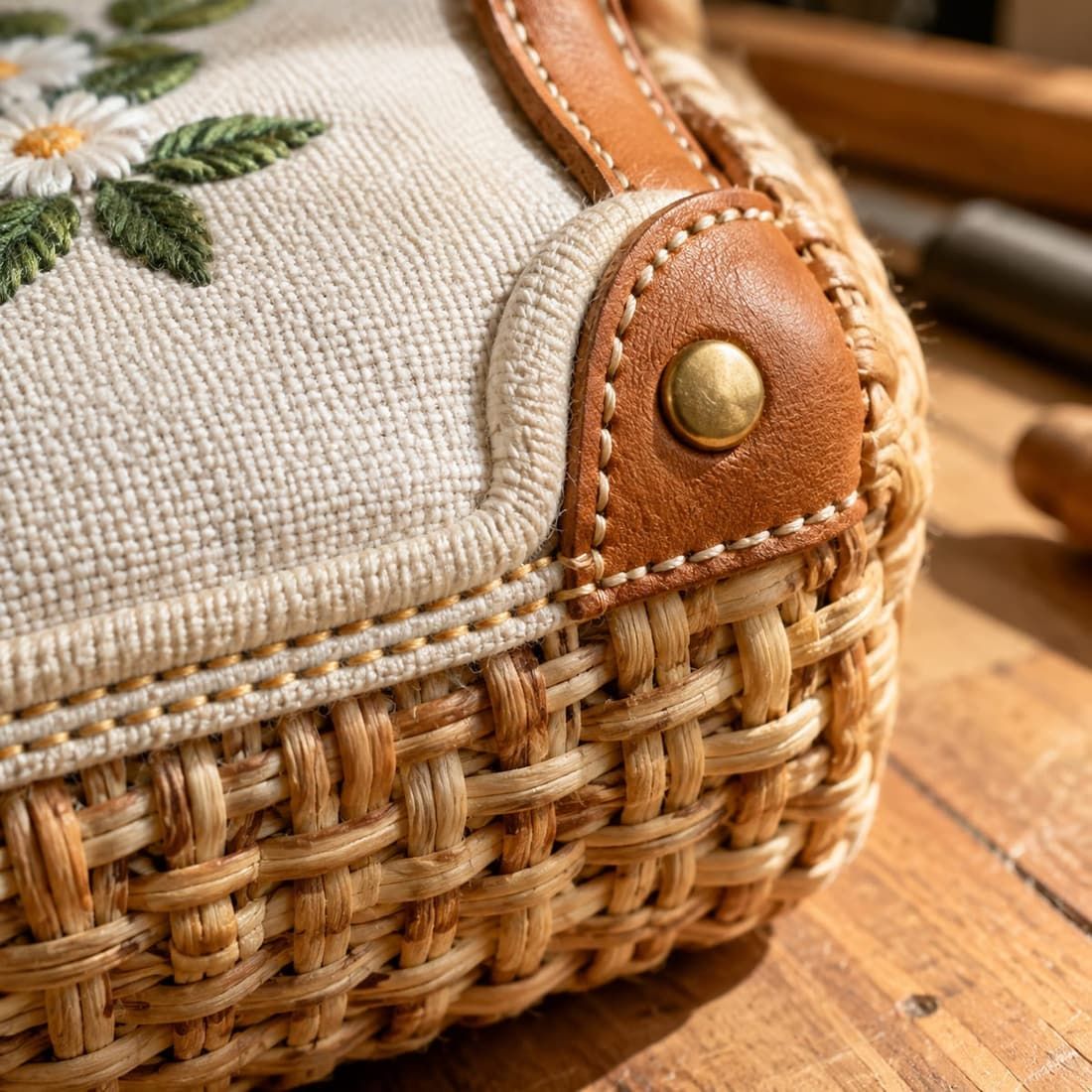
Natural fibers have raw ends that tend to pierce through fabric. We developed a proprietary high-density bound edge piping coupled with dual-pass reverse lockstitching. This hermetically seals the natural fiber tips, eliminating burrs and stopping fraying completely.
Pillar 3: Solid Brass & Full-Grain Leather Anchors
Where handles interface with the basket rim, we reinforce each anchor with vegetable-tanned leather pads and double hollow brass rivets. In dynamic tensile tests, this joint withstands continuous vertical shock loads exceeding 15kg without loosening.
We offer mixed-media prototyping in 10 business days with a starting MOQ of 50 pieces. Tech packs can be sent directly for feasibility review.
Why does an embroidery-to-weaving joint fail first?
Two materials with very different stiffness meet at one seam. Under load the woven body barely moves while the embroidered canvas stretches, so all the movement concentrates in a single stitch line. Add the raw cut ends of natural cane and you get the classic failure: the seam pulls open, the weave slips, and fibre tips work their way through the fabric as frayed burrs.
- Stiffness mismatch: rigid cane against soft canvas concentrates stress at the seam.
- Raw fibre ends: cut rattan and sea grass tips behave like tiny needles and pierce the canvas from inside.
- Needle damage: forcing a machine through cane breaks needles and skips stitches.
- Edge fraying: without a bound edge, the embroidery panel edge unravels as the bag flexes.
- Moisture movement: natural fibre and cotton absorb moisture at different rates, so the seam works loose over time.
How an internal memory core changes the seam
The core is a thin strip of high-recovery boning set under the seam rim. It does not stiffen the bag. It inserts a layer of compliance between two materials that would otherwise fight each other, so load is spread along the strip instead of concentrating on individual stitches and the seam keeps its line under load.
- Placement: under the seam rim, not across the panel, so the bag still folds naturally.
- Weight: the strip adds only a few grams. The difference is in load distribution, not rigidity.
- Shape memory: after compression the strip returns, which keeps the rim line straight in transit.
- What it is not: it does not replace edge binding, nor reinforcement at the handle anchor.
Which edge finish should a mixed-media bag use?
| Edge method | Best for | Trade-off |
|---|---|---|
| Bound edge plus dual reverse lockstitch | Cut natural fibre tips that would fray | Adds bulk at the seam and needs a skilled operator |
| Fold-over binding tape | Thin canvas panels and light bodies | Less protection against stiff cane tips |
| Leather-trimmed edge | Visible luxury detailing and handle areas | Higher cost, and one more material to colour-match |
| Raw edge sealed with adhesive | Not recommended on cane | Adhesive fails with humidity and repeated flex |
QC checkpoints before a mixed-media run ships
- Seam pull test on the finished joint, not on a flat swatch.
- Fibre-tip inspection: run a finger along the inside of the seam to feel for protruding cane.
- Dynamic load test on the handle anchor, because the anchor sees shock rather than only static weight.
- Colour check on both materials after assembly, because dyed canvas and natural cane age differently.
- Needle detection on 100% of pieces: broken needle fragments are the main risk when machining near cane.
Honest limitations
Mixed media costs more and takes longer than either a plain woven bag or a plain embroidered canvas bag, because it needs two skill sets and a controlled join. It is also the wrong choice when the design must fold flat: a woven rim will not pack flat. And no boning layer makes a hand-woven basket indestructible; it manages stress rather than removing it. All figures on this page are workshop-reported benchmarks.
Mixed-media construction questions buyers ask
Can you machine-stitch embroidery directly onto cane?
Not reliably. Cane breaks needles and skips stitches. The embroidered panel is built first, then joined to the woven body with a controlled seam and a reinforced edge.
Does the internal core make the bag stiff?
No. It is a thin, high-recovery strip that spreads load along the seam. The bag still folds and softens with use.
What is the minimum for a mixed-media style?
50 pieces per style and colourway, with sampling from one sealed prototype. Mixed-media pieces sit at the longer end of the 25-35 day bulk window.
Which fibres can be combined with embroidery?
Rattan, carbonised bamboo, sea grass and braided cotton rope are all workable, but each needs a different edge treatment because tip hardness differs.
- Suzani embroidered rattan tote The mixed-media reference style, with stitch and handle detail.
- Rattan vs carbonised bamboo How to choose the woven body for a mixed-media build.
- The 10-day sample workflow How a mixed-media brief becomes a sealed sample.
- Discuss a mixed-media build Send a sketch for a structure and seam review.
If you are evaluating suppliers for a mixed-media programme, three questions separate the ateliers that have built these bags before from the ones that have not. Ask how they handle differential shrinkage between the woven body and the embroidered panel. Ask where in the sequence the panel is tensioned - before or after assembly. And ask for a photograph of the seam on a unit that has been blocked and then rested for a week, not one that came straight off the table. A supplier who answers all three without hesitating has a process; one who answers with a lead time has a price.