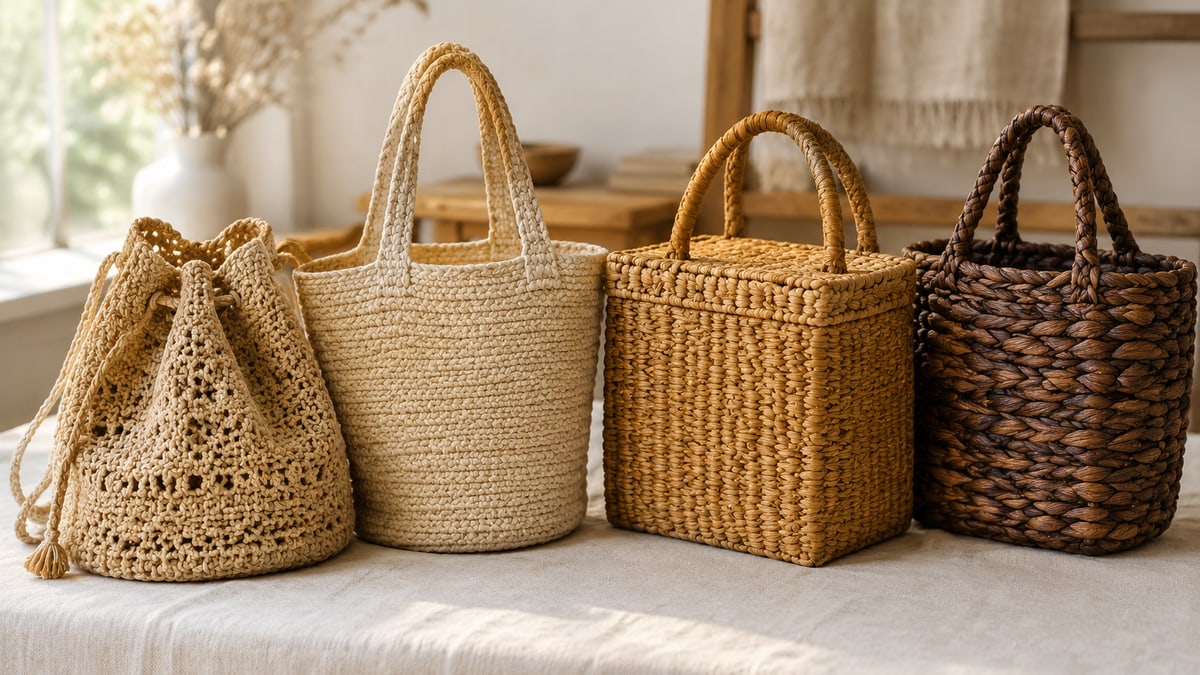
Raffia, paper straw, sea grass and water hyacinth sit behind almost every "straw bag" on a resort shelf, and buyers routinely treat them as interchangeable. They are not. Raffia is a palm leaf that stays supple, paper straw is a twisted cellulose yarn that holds a crease, sea grass is a hard salt-tolerant blade that supplies structure, and water hyacinth is a thick wetland stem that dyes like a textile. Choosing the wrong one shows up later as sagging bases, snapped handles, or a colour that has faded by week three. This guide compares them on the six points that actually decide a purchase order, with the MOQ, sampling and FOB bands we quote from our Dongguan atelier.
- Raffia — softest drape, highest crochet resolution, highest cost; from 50 pcs per style
- Paper straw — cheapest and most uniform, but creases permanently and reads as synthetic up close
- Sea grass — stiffest and most structured; the natural choice for flat totes and box bags
- Water hyacinth — thick, matte and deeply dyeable; use it where the bag must look hand-made
- Sampling runs 10 business days for all four, with a sealed physical sample before bulk
- Every fibre ships on the same 50-piece MOQ and AQL 1.5 inspection standard
Raffia vs straw vs sea grass vs water hyacinth at a glance
| Property | Raffia (palm) | Paper straw | Sea grass | Water hyacinth |
|---|---|---|---|---|
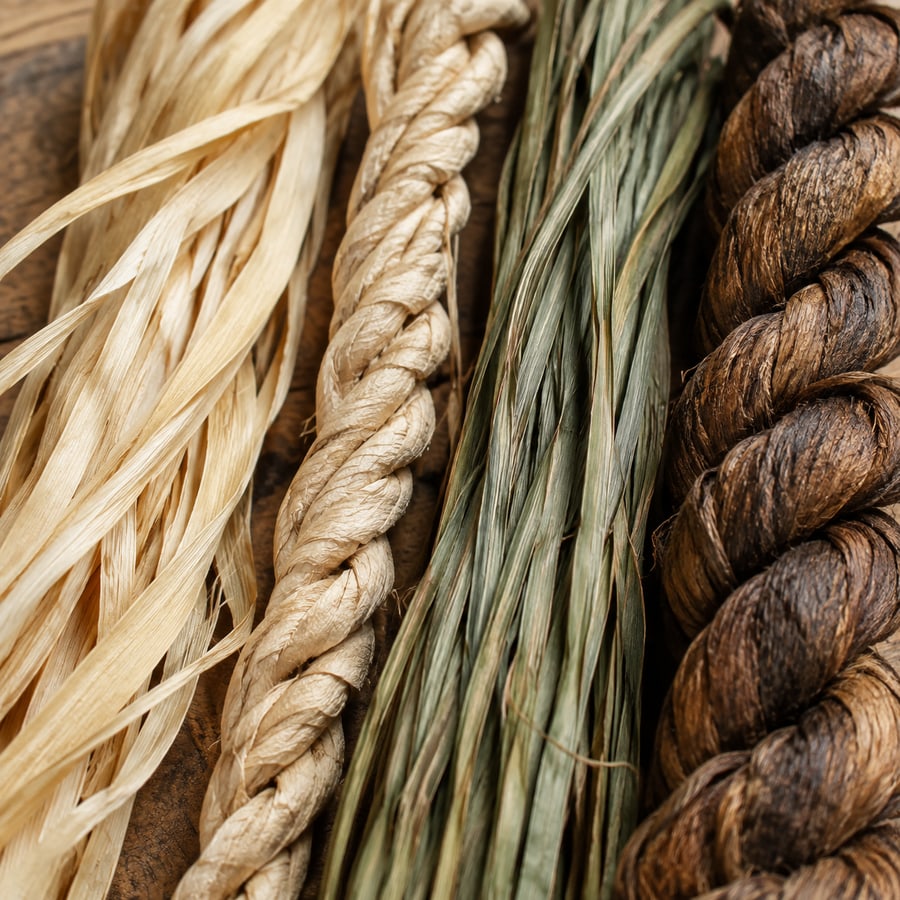
| Fibre type | Split palm leaf | Twisted cellulose yarn | Salt-tolerant grass blade | Wetland plant stem |
| Hand feel | Soft, waxy, flexible | Dry, papery, crisp | Rough, hard, cool | Thick, matte, slightly spongy |
| Structure | Drapes; needs lining | Holds a crease; light | Rigid; self-supporting | Firm but heavy |
| Dye take-up | Even, muted pastels | Pigmented in the yarn | Limited; natural tones | Excellent; deep shades |
| Moisture | Recovers as it dries | Softens and deforms | Very tolerant | Needs sealing against mould |
| Relative FOB | Highest | Lowest | Lower-mid | Mid |
| Best use | Crochet totes, bucket bags, clutches | Volume promos, gift bags | Flat totes, box bags, market baskets | Statement bags, structured buckets |
What raffia actually means
Raffia is the young leaf of Raphia palms, split into narrow strips and dried. Madagascar sets the quality benchmark: long, pale, pliable strips that crochet without splitting. Cheaper origins sell shorter, brittle strips that snap at the handle joint, which is why two quotations for the same word can differ by 40% and both be honest about it.
Two grades cover most production. Grade A natural raffia is un-dyed and waxy, ranging from cream to pale wheat; crocheted at 12 to 14 stitches per 10 cm it is the only sensible choice for bucket bags and clutches. Grade B is shorter and normally goes into accents, tassels or pigmented yarn, where short fibres are spun rather than crocheted.
Paper straw: the honest substitute
Paper straw is cellulose yarn twisted to imitate raffia. It is uniform, cheap, and colours identically lot after lot, which is exactly why large promotions use it. The trade-off is behavioural: paper straw softens with humidity, creases permanently, and loses the waxy sheen that makes real raffia read as natural under retail lighting. If your brand story is sustainability, be explicit about which yarn you are selling, because buyers in the EU increasingly check.
Sea grass and water hyacinth: structure from wetland plants
Sea grass
Sea grass grows on coastal flats and is harvested as long, hard blades. It resists salt air and keeps its own shape, so it suits flat totes, market baskets, and rigid box bags that need no internal frame. Colour stays in the sage-to-wheat range and dyeing is limited — a limitation that is usually the selling point.
Water hyacinth
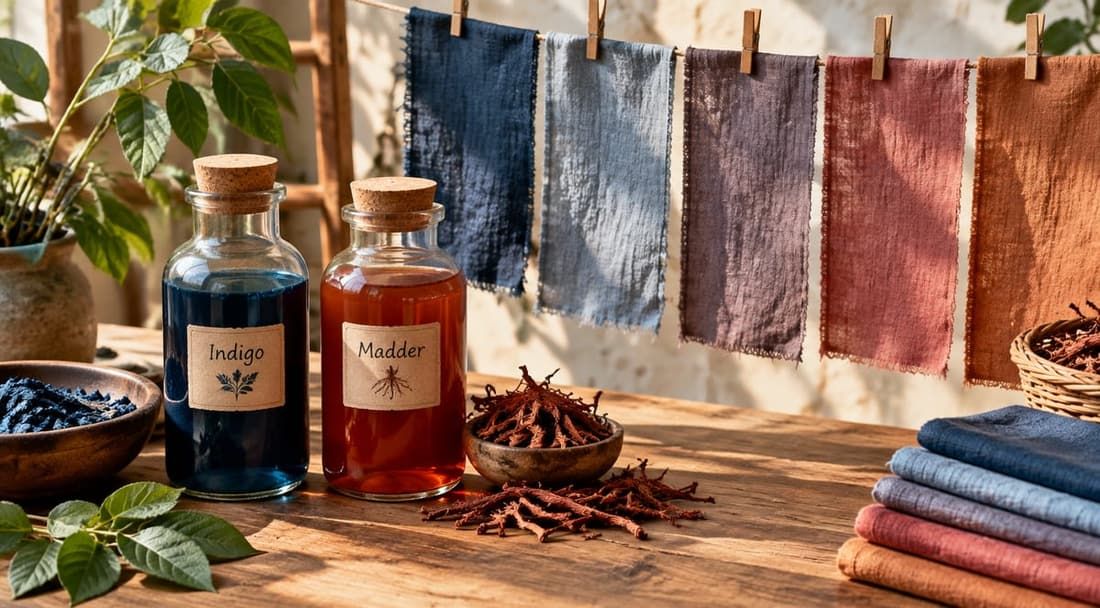
Water hyacinth is the stem of an invasive aquatic plant, dried and twisted into rope or flat strips. It is thick, matte, and unusually good at holding dye, so deep terracotta, olive and indigo shades are realistic. It is also heavy, and in humid climates it needs a sealed or lacquered finish to resist mould — a line worth writing into the spec sheet rather than leaving to the factory.
How to specify a natural-fibre bag that survives a season
- Name the fibre and the grade, not just straw — grade is where the cost sits
- Set a minimum stitch or weave density (12 to 14 stitches per 10 cm for crocheted raffia)
- Specify the base: double-layer weave, or a 1.5 mm board insert under a fitted lining
- Define the handle attachment — hand-rolled, bar-tacked, or riveted through a leather pad
- Require a moisture or lacquer finish for water hyacinth and paper straw
- Approve the sealed sample in the production fibre, never a studio substitute
MOQ, lead time and FOB price by fibre
Between 50 and 500 pieces, fibre choice moves the price far more than volume does. The bands below are what we quote for a lined tote with a leather handle, ex-works Dongguan, for 2026 delivery.
| Fibre | Typical MOQ | Sampling | Indicative FOB | Main price driver |
|---|---|---|---|---|
| Raffia (Grade A, crochet) | 50 pcs / style | 10 business days | USD 14-26 | Hand-crochet hours |
| Paper straw | 100 pcs / style | 7-10 business days | USD 5-11 | Yarn cost |
| Sea grass | 50 pcs / style | 10 business days | USD 9-17 | Blade grade and base board |
| Water hyacinth | 50 pcs / style | 10-12 business days | USD 11-20 | Dyeing and sealing finish |
Frequently asked questions
Is raffia waterproof?
Not waterproof, but water-tolerant: it softens in rain and recovers its shape as it dries. For beach programmes, specify a sealed base and keep paper straw out of the range.
Can paper straw be sold as raffia?
No. They are different fibres with different behaviour, and describing paper straw as raffia is a compliance and chargeback risk in most EU markets.
Which fibre is cheapest at 50 pieces?
Paper straw. The gap narrows above 500 pieces, because hand-crochet labour rather than the fibre itself is the expensive part of raffia.
Can you dye water hyacinth to a Pantone shade?
To a close match rather than an exact one. Natural-stem dyeing is matched by eye under D65 light, and a dyed swatch travels with the quotation.
Which fibre should your line start with?
If the collection is small and the story is craft, start with Grade A crocheted raffia in two silhouettes and add sea grass when you need a flat, structured shape. If the collection is a volume promotion, paper straw gives you the price point. Water hyacinth is the one that makes a buyer stop and pick the bag up — which is usually worth more than the two dollars it costs.
- Raffia crochet bags — craft page Stitch density, leather trim joinery and drawstring construction.
- Material & swatch guide Canvas weights, natural fibre specifications and swatch requests.
- Hand-woven bags — product category Rattan, sea grass, bamboo, water hyacinth and cotton rope series.
- Private label bag manufacturing Your label on our silhouettes, 50-piece MOQ, 10-day sampling.