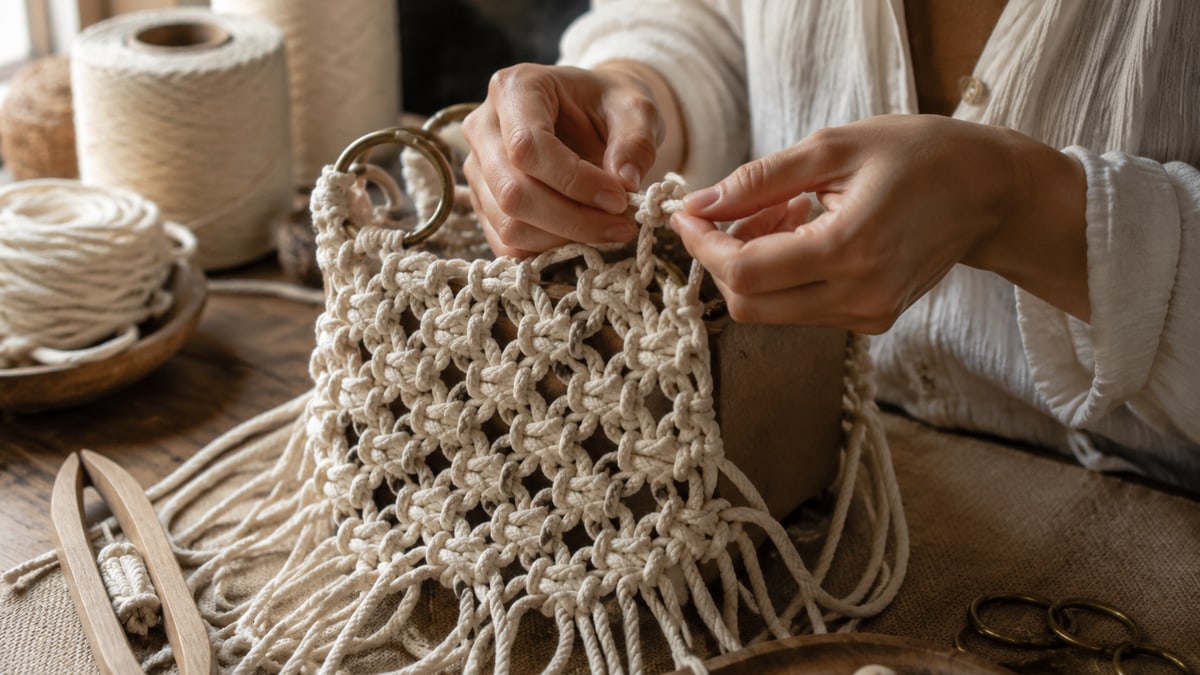
Macramé and crochet are usually filed together, and that is the first mistake a sourcing brief makes. Crochet builds fabric from loops; macramé builds it from knots. That single difference decides how a cotton rope bag carries load, how it is repaired, and how it is priced. A rope bag that sags after six weeks almost always failed at the knot plan, not at the rope. This guide covers the three knots doing the structural work, how rope thickness and twist change the result, and the specification sheet we ask brands to approve before sampling.
- Macramé is knots; crochet is loops. They cannot be substituted in one brief
- Square knot sinnets make flat panels; half-hitch spirals make cord and handles
- Lark head mounts are what stop a handle pulling out of the bag body
- Rope thickness: 4-5 mm for body panels, 6-8 mm for handles and straps
- 50-piece MOQ per style, 10 business days for a sealed sample
- Repair is a knot, not a seam — worth stating in the care label
Macramé vs crochet: why the distinction matters commercially
A crocheted body is a continuous fabric, so it stretches uniformly and holds a lining well. A knotted body is a lattice: it is stronger along the knot columns than across them, and it opens up under load unless the pattern is planned. That is why the same silhouette costs 20 to 30% more in macramé at equal rope weight — the labour is slower and the sampling iteration is longer.
The commercial upside is the same lattice. Macramé bags read as hand-made at three metres, accept chunky rope that crochet cannot hold, and can be finished with visible fringe and tassel details that photograph well in a resort setting.
The three knots that do the structural work
Square knot (flat sinnet)
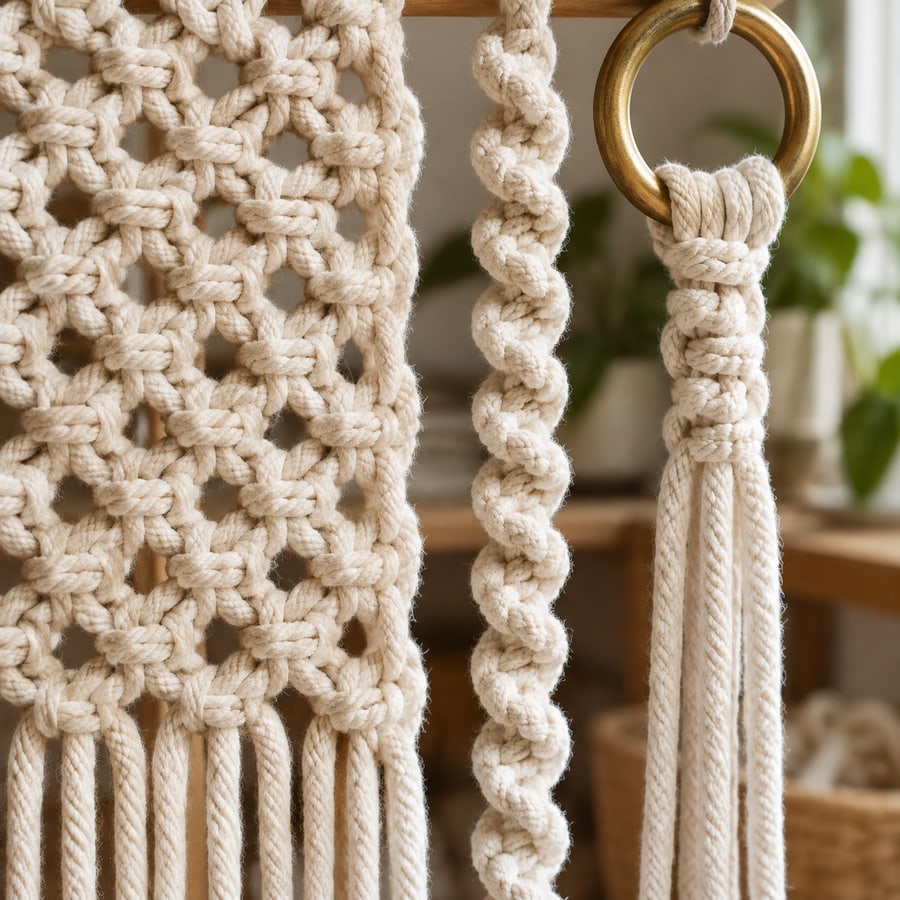
Two working cords and two filler cords alternate left and right to produce a flat, dense panel. It is the standard for front and back panels because it resists twisting and holds a printed lining shape. Density is specified the same way as stitch count: knots per 10 cm, usually 8 to 11.
Half-hitch spiral
Repeating one half hitch around a core creates a spiral cord. It is used for drawstrings, straps and the rope handles on bucket bags, and it is the knot that determines how a strap behaves under load — a tight spiral stays round, a loose one flattens and twists.
Lark head mount
The lark head folds a cord around a ring, rod or rim to fix it in place. Where a macramé bag fails, it usually fails here: a handle knotted onto the panel rather than mounted through a ring will pull the panel out of shape. Specify a lark head mount through a solid brass or leather-bound ring.
Cotton rope: thickness, twist and finish
| Spec | Body panels | Handles and straps | Notes |
|---|---|---|---|
| Diameter | 4-5 mm | 6-8 mm | Thicker rope narrows the achievable knot count |
| Construction | 3-strand twisted | 3-strand or braided | Braided rope resists flattening but knots bulkier |
| Fibre | Combed cotton or cotton-poly | Combed cotton | Cotton-poly holds colour and shape longer outdoors |
| Finish | Waxed or un-waxed | Waxed | Wax stiffens the knot and reduces fraying |
| Colour | Natural, dyed or core-dyed | Same as body | Core-dyed rope hides wear better than surface-dyed |
What to put in the spec sheet
- State knotted (macramé) or crocheted — never both
- Give the knot plan: which sinnet, which mount, and the knots per 10 cm
- Fix the rope: diameter, strand construction, fibre blend, waxed or not
- Define the lining and base: a knotted body needs a fitted lining to hold bulk shape
- Name the handle mount explicitly (lark head through a bound ring, not stitched on)
- Add a load figure: we test finished handles at 15 kg static for 24 hours
MOQ, sampling and where the cost sits
For a lined knot bag with rope handles we quote from 50 pieces per style, with a sealed sample in 10 business days and the sample fee refunded on orders above 200 pieces. Cost is dominated by knotting hours, so two changes move the price more than volume: reducing the panel area, and simplifying the mount to a single ring per handle.
| Configuration | Relative cost | Why |
|---|---|---|
| Open tote, single-layer panel | Base | Least knotting per square centimetre |
| Lined tote, rope handles | +25-35% | Fitted lining and two mounted handles |
| Bucket bag with drawstring | +40-55% | Spiral cord drawstring and rounded base |
| Full macramé with fringe | +60-80% | Decorative knotting is hand time, not material |
Frequently asked questions
Is macramé stronger than crochet?
Not inherently. A knotted panel is stronger along its knot columns and weaker across them. Strength comes from the knot plan and the rope, not from the technique name.
Can a macramé bag be machine washed?
No. Washing loosens knots and deforms the lattice. Spot clean and re-tighten, which is why we print knot-care instructions on the label.
What rope should a first sample use?
5 mm waxed combed cotton, three-strand, natural or core-dyed. It knots cleanly, photographs well, and is the safest starting point for a resort range.
How does a rope bag hold its shape?
From a fitted lining and a reinforced base, not from stiffener. A knotted body with a loose lining will stretch; the lining is doing the structural work.
Where macramé earns its premium
Macramé pays off where the bag has to be touched: market and beach totes with visible rope handles, bucket bags with hand-knotted drawstrings, and any piece where the brand sells craftsmanship rather than convenience. If the range is a volume promotion, the same silhouette crocheted in raffia will land cheaper and faster to make — but it will not photograph the same way.
- Macramé & cotton rope — craft page Knot plans, rope specifications and handle mounts.
- Raffia bags explained: four fibres compared How raffia, straw, sea grass and water hyacinth differ.
- Hand-woven bags — product category Rattan, sea grass, bamboo and cotton rope series.
- How to create a production-ready bag tech pack Dimensions, seam allowances and a BOM template.